
Continuum of Motivation
Over time, our motivations evolve between extrinsic (in the world) and intrinsic (in ourselves).
Does your gym have a crew of older black belts who use the Jiu-Jitsu mats as their personal social club? 🤣
I used to wonder what the deal was with those guys...
And now, in my mid-40s with almost 20 years of experience in the sport, I am one of those guys!
I've become one of those old dudes who talks like a wannabe Jiu-Jitsu philosopher.
Ask me how to finish an armbar, and I'll give you a confusing response like:
“What IS an armbar? Why are you trying to do such a thing? What is your purpose? Why are you EVEN HERE?”
Beginners hate when black belts talk like this, because the answer they received doesn't seem to match their question. But the black belt's perspective is obviously different.
I've generally found that beginners talk about Jiu-Jitsu as a thing you do, whereas black belts speak about it as a way of life.
This phenomenon has a name: the continuum of motivation.
The continuum of motivation
The continuum of motivation is a concept from self-determination theory. I explain it as follows:
Over time, our motivations evolve between extrinsic (in the world) and intrinsic (in ourselves).
Extrinsic motivation comes from the world. It's when you measure your performance against things outside of yourself, such as tournament results, medals won, or how you fared against an opponent.
Intrinsic motivation comes from within yourself. It's when you do things for the love of the game. The work becomes its own reward. When we tell our students to “be better than the person you were yesterday,” we're talking about intrinsic motivation.
Barbara Bray and her colleagues made a fantastic illustration of this concept, which I'll include here:
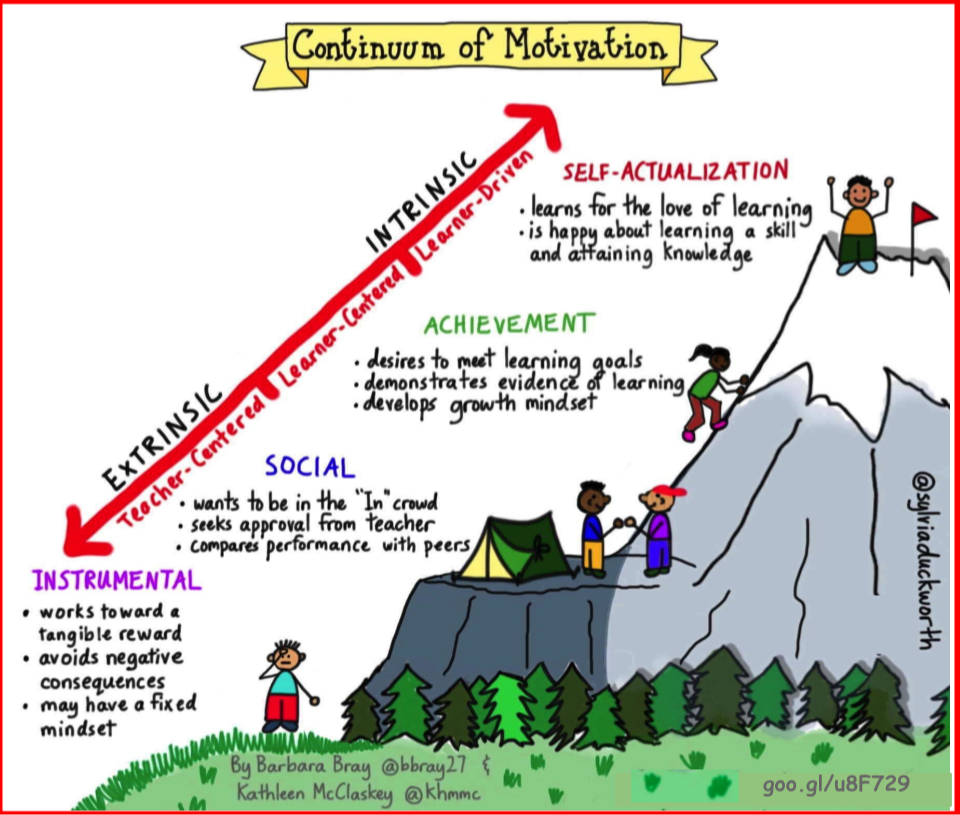
As much as I appreciate Barbara Bray's “mountain” illustration, I have one criticism:
It presents intrinsic motivation as being “better” than extrinsic motivation, but that's not always true.
Intrinsic, self-actualized motivation is often presented as a form of enlightmentment. In Barbara's illustration, it's literally drawn as ascending to the top of a mountain.
This framing makes intrinsic motivation look like the final goal or outcome — the end of the journey.
However, motivation is not a one-way track. The journey between extrinsic and intrinsic motivation is a continuum (hence the name). There is no final “enlightened state” where we can claim to have mastered the process.
Sometimes you'll be motivated more extrinsically, such as when you're preparing for an upcoming tournament.
Other times, you'll be motivated intrinsically: doing Jiu-Jitsu because you love it, not for the sake of any desired outcome.
Yes, intrinsic motivation is often more sustainable over the long term. Because it is self-driven and self-fulfilling, intrinsic motivation can lead to greater enjoyment and consistency, which prevents burnout and increases your odds of long-term success.
However, we would be fools to ignore the importance of extrinsic motivation. Sometimes, there is a job in front of you that just needs to be done.
For the best long-term results, I'd suggest we strive towards an ongoing intrinsic motivation, while also being mindful that sometimes extrinsic things are important and should be treated as such.
The continuum of motivation is an example of what multi-time world champ Emily Kwok calls a polarity: a concept that exists not in absolutes, but on a spectrum.
With polarities, there often isn't a “right” or “wrong” side to be on, but rather an acknowledgement that our journey requires us to transition in between.
As the world's most famous martial arts philosopher once said, “Only a Sith deals in absolutes.” 🤣
On the podcast:
Further study:
Master this mental model with our audio courses.
Learn over 150 mental models for Jiu-Jitsu.
Exclusively on BJJ Mental Models Premium.
Try it free. Cancel anytime. No bullshit. Only $20/mo.
GET STARTED NOW

